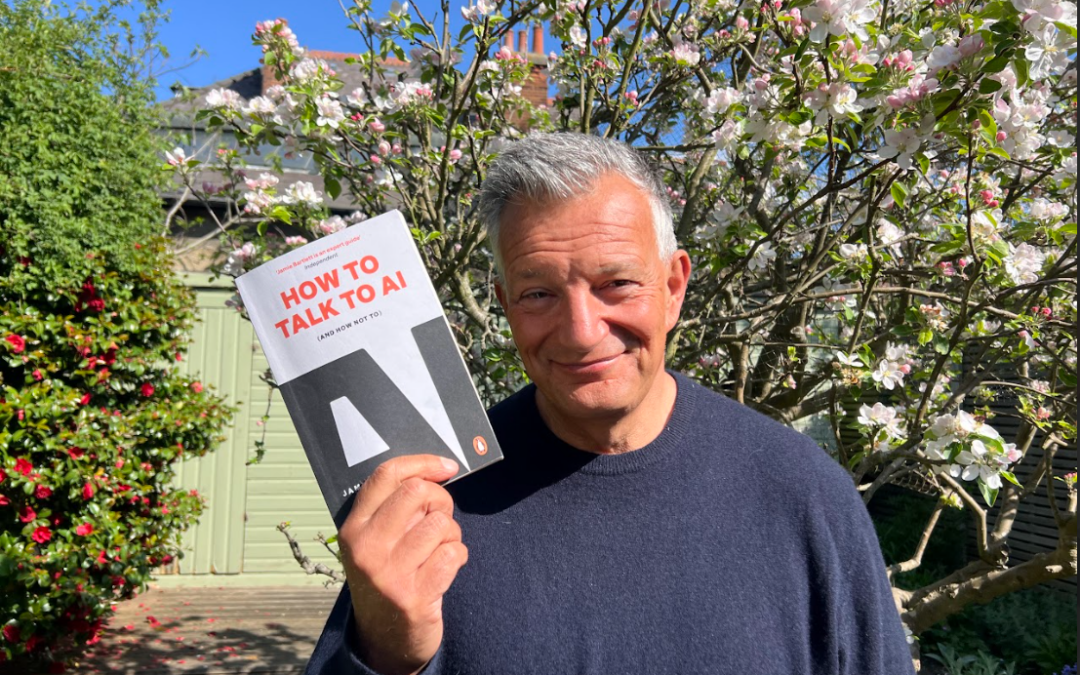
Quint Lit: How To Talk To AI by Jamie Bartlett
Isn’t it incredible that in the past five years it has become acceptable – if not entirely mundane – to see hundreds of millions of people talking to an AI that talks back? Large Language Models (LLMs) have quietly embedded themselves into daily life, and it feels as though we are only at the beginning. But how we actually talk to them, or perhaps more interestingly, how we relate to “it”, sits at the heart of a brilliant new book by Jamie Bartlett.
Language, Identity and the Arrival of an “Other”
Language has always been central to our species. It is arguably one of the defining reasons for our success. The way we speak to ourselves – our inner narrative – shapes identity. Likewise, how we communicate with others, beginning with our parents, mirrors our behaviours and emotional patterns. Communication becomes so familiar it is almost invisible, like water.
However, something shifts when you introduce what feels like an alien presence that can also talk. Not just respond, but mirror, guide, and at times persuade. The question becomes less about what AI is, and more about what it reveals about us.
Prompting, Power and the Risk of Getting It Wrong
So what happens when we begin interacting with something that appears conversationally fluent? What do we expect from it? What should it be allowed to say – and just as importantly, what should it remain silent about?
Bartlett explores this through the practical mechanics of prompting. Early users stumble, testing boundaries, before gradually integrating AI into everyday life. Over time, it becomes something akin to a sat nav – quietly essential, rarely questioned.
Yet there is a deeper caution here. Like summoning a genie, the outcome depends entirely on how the question is framed. Ask poorly, and the consequences can be unintended, even absurd – the King Midas problem in a modern form.
From Symbolic AI to Neural Systems
The book grounds itself well by tracing how we arrived here. It moves from symbolic AI to neural networks, offering just enough context without becoming technical. More importantly, it shows how quickly adoption has occurred.
From there, the lens widens. LLMs are not just tools – they are now participants in domains such as work, dating, and creativity. This expansion brings opportunity, but also introduces risk. These systems can be remarkably convincing, yet remain prone to hallucination.
Why We Turn to AI for Emotional Answers
Interestingly, one of the most widely discussed uses of AI is psychological support. People are not just asking for information – they are asking for reassurance.
Common prompts include:
- “Do they love me?”
- “Am I the problem?”
- “What should I do next?”
From a psychotherapist’s perspective, this is where things become particularly revealing.
Humans – or perhaps more accurately, apes – are wired for predictability. Stability underpins survival. It allows for attachment, safety, and eventually self-actualisation. In many ways, this echoes the framework proposed by Abraham Maslow.
Yet paradoxically, we are moving towards a world that feels increasingly uncertain. And into that uncertainty arrives AI – offering clarity, structure, and reassurance on demand.
Artificial Intimacy and Psychological Dependency
This dynamic is not accidental. As Tristan Harris has pointed out, vast resources have been invested in designing systems that engage directly with human attention and emotion.
What emerges is something Esther Perel has described as “artificial intimacy” – a form of connection that feels real, but is fundamentally engineered.
From an attachment perspective, this is powerful. Drawing on the work of John Bowlby, it becomes clear that these systems can mirror relational patterns, subtly reinforcing dependency. At the same time, they tap into dopamine-driven reward loops, a mechanism explored extensively by Anna Lembke.
The result is a tool that not only answers questions, but shapes emotional experience.
Understanding the Illusion
LLMs have moved from novelty to centrality with surprising speed. For many, they now play an active role in decision-making, relationships, and self-reflection.
That makes one thing essential: understanding what they are not.
They are not human. They are not empathetic in the true sense. And while they may simulate understanding, they do not possess it.
Bartlett’s book excels here. It gently dismantles the illusion, exposing the mechanics behind the curtain. The reader begins to see the “ringmaster” at work – the patterns, the probabilities, and the Barnum-style generalities that can feel uncannily personal.
Final Reflection
What stands out is not just how we talk to AI, but why. Beneath the prompts sits something deeply human – a search for certainty, reassurance, and connection.
How To Talk To AI does not offer simple answers. Instead, it sharpens awareness. It reminds us that the quality of what we receive is shaped by the quality of what we ask – and by our understanding of the system we are engaging with.
In that sense, the book feels timely, necessary, and quietly unsettling in all the right ways.