
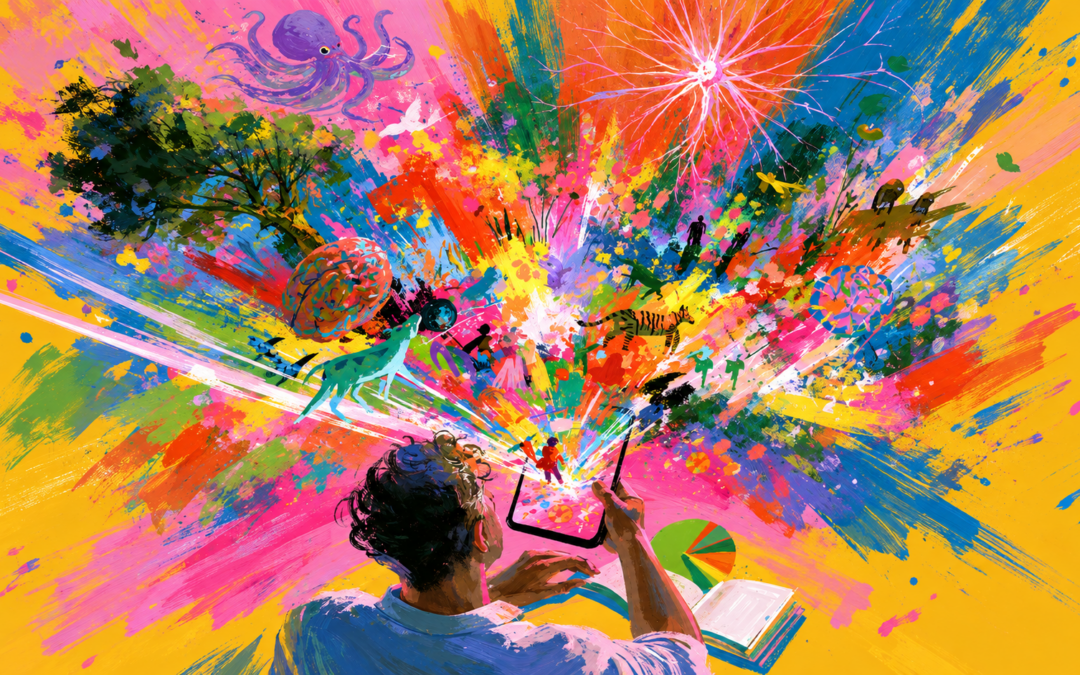
Beyond Words: Why Mental Health Needs a Better Language
At the end of October, I will publish a book that brings together two parts of my working life which, for many years, I thought were largely separate.
The book is called Beyond Words: A Manifesto for Animation, AI and the Future of Mental Health Communication. It draws on nearly thirty years of working as a psychotherapist and more than twenty-five years working in film and animation. Increasingly, I have come to think that these two careers have been circling the same problem: how do we help another human being understand something complicated?
In mental health, we have become remarkably good at naming things. Anxiety, trauma, ADHD, attachment, depression, addiction and narcissism are now part of everyday conversation. That represents progress. Experiences that might once have been hidden, minimised or misunderstood are discussed much more openly in schools, workplaces, families and on social media.
But there is a problem. Knowing the word is not the same as understanding the process.
Someone can know that they have anxiety without understanding what their anxiety is doing. They can recognise the language of attachment without seeing the pattern unfolding in their own relationship. They can describe themselves as depressed while still struggling to communicate what depression actually feels like from the inside.
We have, in other words, become increasingly fluent in the vocabulary of psychology without necessarily becoming equally fluent in psychological understanding. The menu is not the meal.
This matters because much of mental healthcare still depends heavily on language. A clinician explains. A patient listens. A leaflet is handed over. A website is recommended. A diagnosis is described. A young person is expected to make sense of what is happening to them through words at precisely the moment when words may be hardest to find.
Sometimes the difficulty is not simply that the language is too technical. Sometimes there are no words yet. An experience may begin as a sensation, an image, an urge, a fragment of memory or a feeling that something is wrong long before it can be organised into a coherent story.
Children make this especially obvious, but adults are hardly immune. Anyone who has tried to describe panic, shame, grief, craving, love or loneliness knows how quickly apparently sophisticated language can run out.
This is where animation becomes interesting to me.
Animation can make the invisible visible. It can show a psychological process unfolding over time. It can give form to something that is difficult to describe and create enough distance for somebody to recognise a pattern without being overwhelmed by it.
Anxiety, for example, might be represented as an octopus whose arms both protect and constrain. Shame can shrink a character. Depression can drain colour from a room. A relationship pattern can become a loop in which two people repeatedly return to the same unhappy position.
None of these images claims to be the experience itself. They are models. Metaphors. Ways of thinking. Their value lies in giving us something we can look at together.
That distinction matters. I am not arguing that animation is a treatment, nor that a well-made film can replace a therapist, doctor, teacher or parent. Sometimes medication will matter most. Sometimes the crucial intervention will be two people sitting together in a room. Animation belongs alongside those things, not above them.
What interests me is the possibility that we have undervalued communication itself as part of healthcare.
We spend enormous sums diagnosing, treating and caring for people, yet the comparatively modest task of helping someone understand what is happening can still depend on a consultation they barely remember, a printed leaflet, or a webpage they may never return to.
In other parts of life, we behave very differently.
A child does not learn to tie their shoelaces from a sophisticated verbal description of loops, tension and sequence. We show them. Engineering uses diagrams. Medicine uses scans and models. Financial institutions and technology companies routinely use animation to explain systems that are complex, abstract or impossible to film.
Yet when we move into psychological health, we often return almost entirely to words.
That seems increasingly strange.
One of the reasons I have written Beyond Words now is that artificial intelligence is changing what is possible. Historically, high-quality animation has been expensive. That has limited its use, particularly for charities, public bodies, schools and smaller healthcare organisations.
AI is beginning to alter that economics dramatically. Production can become faster. Translation and localisation can become easier. Different versions can be produced for different audiences. Material can be updated instead of becoming obsolete.
The interesting question, therefore, is no longer simply whether we can afford to use animation more widely. It is whether we can afford to ignore a medium that may help people understand complicated experiences more clearly.
AI also makes judgement more important, not less. If visual content becomes cheap and plentiful, then deciding what should be represented, how it should be represented and whether it is psychologically accurate becomes increasingly important.
A beautiful animation that communicates the wrong idea is still wrong.
That is why I believe clinicians, people with lived experience, educators, writers and filmmakers need to be involved together. Good mental health communication cannot simply be a production exercise. It requires psychological judgement as well as creative judgement.
The starting point for the book is therefore a simple proposition: information is not understanding.
We have spent years improving access to information. That has been valuable. But the next challenge may be to become much better at turning that information into something people can genuinely grasp, remember and use.
Animation will not revolutionise healthcare on its own, and claims of that kind deserve suspicion. But it may offer a practical, scalable and increasingly affordable way of addressing one of healthcare’s oldest problems: helping one human being understand something another human being is trying to explain.
That is the argument I explore in Beyond Words.
The book will be published at the end of October. Over the coming weeks, I will also be releasing the audio version through my AI Script to Screen podcast, beginning with the Preface and then moving through the book chapter by chapter.
For most of my working life, I thought psychotherapy and animation were two separate careers. I am beginning to think they were two routes towards the same question.
How do we help people see what words alone cannot always explain?
by Quint Boa, AI Video Executive & Producer
Quint is an Executive Producer specialising in AI video production for the healthcare sector. Quint has worked for over 40 years in the film, radio, and television industries. Twenty-five years ago, he founded Synima, a global video production company. Quint has embraced artificial intelligence in the creative process. Working with trusted colleagues, he’s developed a hybrid approach to AI within video production that expedites workflows and reduces costs. Quint believes ‘your health is your wealth’ and is enthiastic about every aspect of healthcare. As a UKCP-qualified psychologist, Quint feels uniquely equipped to support the communication challenges the healthcare faces by combining his experience with AI video production techniques, psychological insight and practical solutions.