
AI Video Production to Explain Drugs to Young Adults – Case Study
AI character animation and the everyday language of pain and sleep
Where this project came from
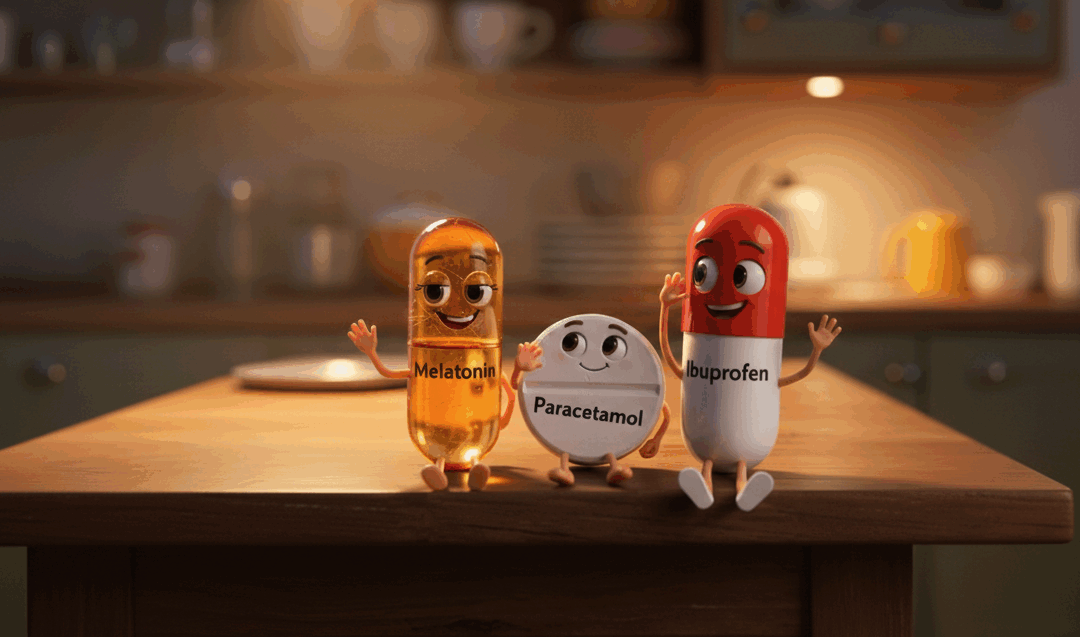
This short film was developed as an exploratory piece of AI-supported healthcare storytelling designed for social media. The aim was not to market products or deliver clinical guidance, but to test how artificial intelligence could be used to translate familiar medical concepts into accessible, emotionally intelligible narratives. The central idea was simple. Rather than explaining pain relief or sleep regulation through diagrams or medical terminology, the film personifies three widely recognised medicines: paracetamol, ibuprofen and melatonin. Each character speaks in plain language, introducing what they do and offering a small piece of factual context. The result is a brief, playful learning moment. Yet beneath its lightness lies a more serious question: how might AI-driven animation help healthcare communication move beyond instruction toward understanding? This project sits within a broader exploration of AI as a production tool that supports clarity and speed without displacing human judgement or clinical responsibility. The technology accelerated visual development, but the narrative logic remained human-led.The wider context
Healthcare communication increasingly takes place in environments shaped by speed, distraction and algorithmic attention. Social media platforms reward immediacy rather than depth. At the same time, public understanding of everyday medicines remains uneven. People often know what they take, but not how or why it works. Traditional educational content tends to oscillate between two extremes: oversimplification that risks inaccuracy, and technical detail that alienates non-specialists. Between these poles lies a quieter problem. People do not merely need information. They need language that feels comprehensible, relatable and emotionally grounded. AI-driven character animation offers a potential bridge. By giving abstract concepts a voice and personality, it becomes possible to speak about pain, sleep and inflammation without resorting to either clinical jargon or sensationalism.The constraints
From the outset, the project operated within deliberate limits. The film could not make medical claims, comparisons, or therapeutic recommendations. It had to avoid persuasive language and remain informational in tone. The characters needed to feel approachable without becoming misleading or anthropomorphic in ways that distorted clinical meaning. AI tools were used to support visual generation, animation and iteration. They were not used to determine medical content or narrative framing. Responsibility for script, tone and factual accuracy remained with the production team.Here, constraint was not a technical obstacle but an ethical framework. The point was not to demonstrate what AI could do, but to explore how it could be used responsibly.
Visual language and voice
The visual approach drew on a stylised but grounded aesthetic. The characters are recognisable as medicines, yet softened by human-like expressions and gestures. Their movements are minimal. Their voices are calm, friendly and restrained. Each character speaks briefly. Paracetamol describes easing everyday pain. Ibuprofen references inflammation. Melatonin frames sleep as a natural process supported by the body. A single factual detail is introduced in each case, not as instruction but as context. Nothing is heightened for drama. The tone is deliberately modest. The aim is not persuasion but familiarity.Why animation worked here
Animation makes it possible to express ideas that are difficult to convey through traditional live-action formats. Pain, sleep and inflammation are not easily visualised. Nor are they easily discussed without drifting into either technical abstraction or emotional exaggeration. By giving these processes a voice, animation creates a form of symbolic shorthand. It also offers distance. By speaking through characters rather than clinicians or patients, the film avoids both authority and vulnerability. This distance allows viewers to engage without feeling instructed, judged or exposed. In a social media environment, where attention is brief and scepticism is high, this balance becomes crucial.My role in the project
As Executive Producer, I led the conceptual development and AI-supported production workflow. This included shaping the narrative structure, defining boundaries around medical content, and guiding the integration of AI tools into the creative process. The challenge was not technical complexity but tonal precision. The film needed to feel light without becoming trivial, educational without becoming didactic, and human without becoming sentimental. Throughout the process, human oversight remained central. AI functioned as an accelerator of production rather than an author of meaning.Safeguards and governance
The film contains no medical advice, comparative claims or therapeutic recommendations. Language remains descriptive and neutral. AI-generated elements were limited to visual and animation processes. Script development and factual framing were conducted through human-led editorial control. This separation ensured that efficiency gains did not undermine accuracy or trust.After release
The film was designed as an example piece rather than a campaign asset. Its primary purpose was to demonstrate potential use cases for AI in healthcare communication on social platforms. Early feedback suggested that viewers found the characters intuitive and engaging. The simplicity of the format encouraged completion rather than abandonment, a persistent challenge in short-form educational content. More importantly, the piece opened conversations about how AI might be used not only to scale content but to soften the language of medicine.Reflections
This project illustrates a modest but revealing possibility. AI does not need to replace human storytelling in healthcare. Instead, it can create new forms of translation between clinical knowledge and everyday experience. By reducing complexity without erasing meaning, character-based animation offers a way of speaking about health that is neither purely technical nor emotionally inflated. In a digital environment saturated with information, clarity is not achieved through louder messages, but through quieter ones that people can recognise themselves in. Here, the starting point was not innovation for its own sake. It was the question of how everyday medicines might speak if they could. AI simply made that question easier to explore.by Quint Boa, AI Video Executive & Producer
Quint is an Executive Producer specialising in AI video production for the healthcare sector. Quint has worked for over 40 years in the film, radio, and television industries. Twenty-five years ago, he founded Synima, a global video production company. Quint has embraced artificial intelligence in the creative process. Working with trusted colleagues, he’s developed a hybrid approach to AI within video production that expedites workflows and reduces costs. Quint believes ‘your health is your wealth’ and is enthiastic about every aspect of healthcare. As a UKCP-qualified psychologist, Quint feels uniquely equipped to support the communication challenges the healthcare faces by combining his experience with AI video production techniques, psychological insight and practical solutions.