
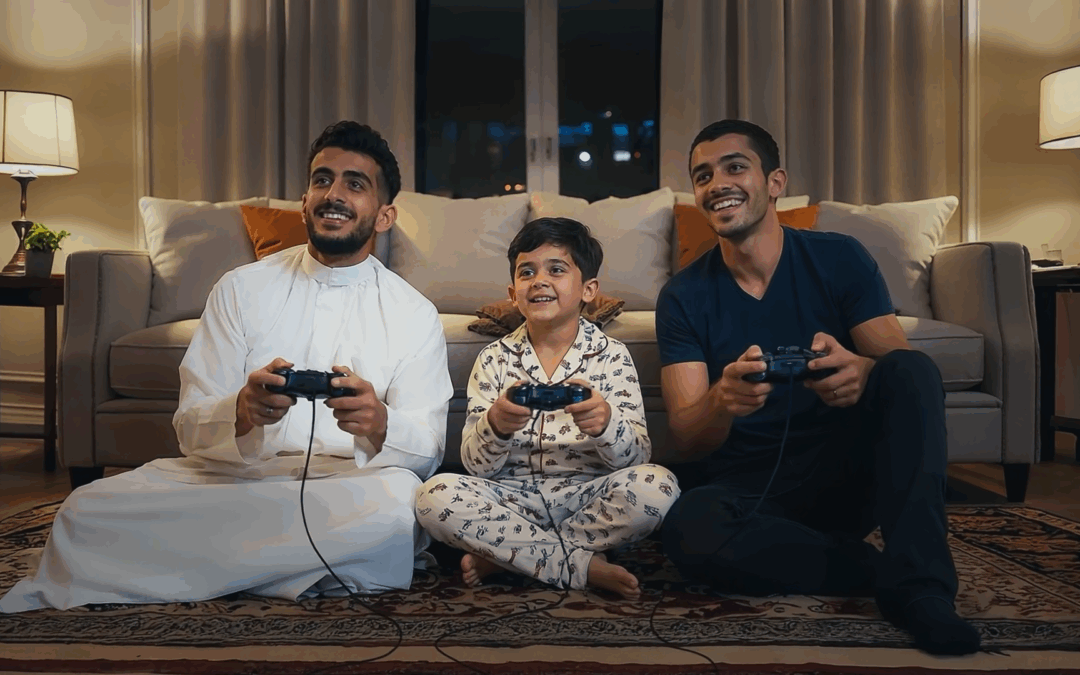
Like Card Case Study
A commercial built with AI, without treating AI as the story
This was the breakout success of 2025, and it couldn’t have happened with a better client. The white-label relationship with the advertising agency worked hand in glove. As the AI video production software developed, we were able to implement it across the project to ensure at the time of release, the video was the very best it could be. And tremendous thanks to the agency for being hands-off enough ad trusting us to develop the AI capability and apply it to their commercial which ensured its fantastic success. This project stands as a demonstration of how well an agency and an AI production company can work in order to guarantee complete success. While it may feel slightly daunting for an advertising agency to relinquish control of the creative process to the degree that working in AI necessitates , this project demonstrates that great things can happen, if they do.
How the project came about
This project started with a practical question rather than a technical one.
80’s Creative, an advertising agency based in Riyadh, was developing a campaign for LikeCard and needed to move quickly from concept to finished film. The creative idea was ambitious and visually bold, but timelines were tight. Traditional production routes would have made that difficult.
I was brought in to explore whether AI-supported video production could realistically deliver the work at an advertising standard, not as an experiment, but as a proper commercial output. From the outset, cultural relevance and regional specificity were part of the brief, not an afterthought.
The context
The agency had a clear creative treatment and a strong sense of tone. What they needed was confidence that the idea could translate into moving image without compromise.
AI was considered because of speed and flexibility, not novelty. The question was whether it could be used in a disciplined way, with enough control to meet agency expectations while still allowing the work to adapt across regions and languages.
The main challenge
The pressure point in this project was time.
The agency needed early proof that the concept could work visually. At the same time, quality could not slip. Characters, environments, and overall tone needed to remain consistent, even as the film was being built at speed.
The commercial also had to function across multiple markets. That meant thinking ahead about language, pacing, and cultural cues, rather than treating localisation as something to deal with later.
Who it was really aimed at
The commercial needed to work across very different audiences, often in places where context would be thin. In some cases it would be seen as part of a broader digital campaign. In others, it would appear on its own, without explanation.
That meant the work had to hold together visually and narratively, even when viewers arrived at it from different platforms or regions. Brand cues needed to remain clear, but not rigid. The balance was always between recognisability and flexibility.
My involvement
I took responsibility for the project end to end.
That meant staying close to the agency’s original intent while making practical decisions about how the work would actually be produced. A lot of this happened early. Choices about tools, sequencing, and quality thresholds shaped everything that followed.
The aim was not to showcase technology, but to make sure nothing in the process undermined the standard expected of an agency-led commercial.
Early work
The starting point was a detailed creative treatment from 80’s Creative.
Rather than moving straight into full production, we focused on testing whether the idea could live on screen. Within the first week, a proof of concept was developed that allowed tone, movement, and visual language to be assessed properly.
Only once that felt right did the rest of the work move forward. Characters, environments, and the overall visual world were defined early, which reduced drift later on.
Making the film
Production moved in stages rather than as a straight line.
Scenes were built, reviewed, adjusted, and sometimes rebuilt. Lighting, movement, and continuity were checked repeatedly. AI made iteration faster, but it did not make decisions. Those stayed with the team.
Speed came from revisiting work quickly, not from accepting the first usable result.
Language and regional versions
Different language versions were planned from the outset.
The commercial launched with both American English and Arabic voiceovers. Timing and pacing were adjusted so each version felt intentional, rather than translated. This mattered, particularly in regions where audiences are sensitive to tone.
Under more traditional production models, this kind of localisation would have required separate builds. Here, changes could be made without dismantling the film itself.
Finishing the work
Once animation was locked, attention shifted to detail.
Colour was balanced across scenes to keep the visual world coherent. Voice recordings were completed in multiple languages. Final audio work pulled everything together. The goal was a finish that felt considered, not automated.
Decisions around tools
Only a small number of AI tools were used, each for a specific purpose.
Reliability mattered more than novelty. Throughout, I remained responsible for ensuring the technology stayed in service of the idea, not the other way around. Oversight around quality, ownership, and delivery standards stayed human-led.
What came out of it
The finished commercial stayed close to the agency’s original vision.
Using this approach made it possible to move quickly and to adapt the work for different audiences without starting again each time. For LikeCard, that meant reaching multiple regions without multiplying production cycles.
A final thought
This project wasn’t about proving a point about AI.
It was about whether a commercial could be made properly, at speed, and still hold together creatively across languages and regions. In this case, the technology helped because it stayed in the background.
Where this approach fits
This way of working suits campaigns that need to move across borders without losing shape.
When creative direction is clear and the process is tightly held, AI-supported production can offer flexibility without diluting standards. That, more than anything else, is what made this project workable.
by Quint Boa, AI Video Executive & Producer
Quint is an Executive Producer specialising in AI video production for the healthcare sector. Quint has worked for over 40 years in the film, radio, and television industries. Twenty-five years ago, he founded Synima, a global video production company. Quint has embraced artificial intelligence in the creative process. Working with trusted colleagues, he’s developed a hybrid approach to AI within video production that expedites workflows and reduces costs. Quint believes ‘your health is your wealth’ and is enthiastic about every aspect of healthcare. As a UKCP-qualified psychologist, Quint feels uniquely equipped to support the communication challenges the healthcare faces by combining his experience with AI video production techniques, psychological insight and practical solutions.