Access City Award Case Study
Making accessibility visible across Europe
How this work came about
Accessibility is rarely understood through policy language alone. For most people, it is felt in small, ordinary moments: getting on a bus, finding information, moving through a public space without friction.
This project grew out of that gap. The European Commission needed a way to communicate what the Access City Award actually represents, not just in terms of criteria or governance, but in terms of lived experience.
I was brought in as Executive Producer to oversee a series of official films that could explain the award, encourage participation from cities across Europe, and frame accessibility as part of everyday civic life rather than a technical obligation.
The wider context
In the years following COVID, the meaning of accessibility shifted.
Cities were not only restoring infrastructure. They were rebuilding trust, social connection, and public life. Disabled communities had experienced disproportionate disruption, reduced access to services, and extended isolation. Against that background, inclusion could not be communicated as an abstract policy aim. It needed to feel immediate and human.
The Access City Award provided a useful anchor. It already recognised long-term effort rather than one-off interventions. The challenge was how to communicate that ethos clearly, across countries, languages, and cultures.
The communication problem
Accessibility spans transport, housing, public space, digital services, information, and participation. Explaining all of that through text alone is difficult.
Written material also creates its own barriers. Language, literacy, and cognitive load all affect who can engage. For a pan-European audience, those limitations become more pronounced.
The films needed to show how accessibility works in practice. They also needed to avoid stereotyping or simplifying disability. The aim was to make inclusion recognisable without turning it into a checklist.
Why video made sense
Video allows accessibility to be shown rather than described.
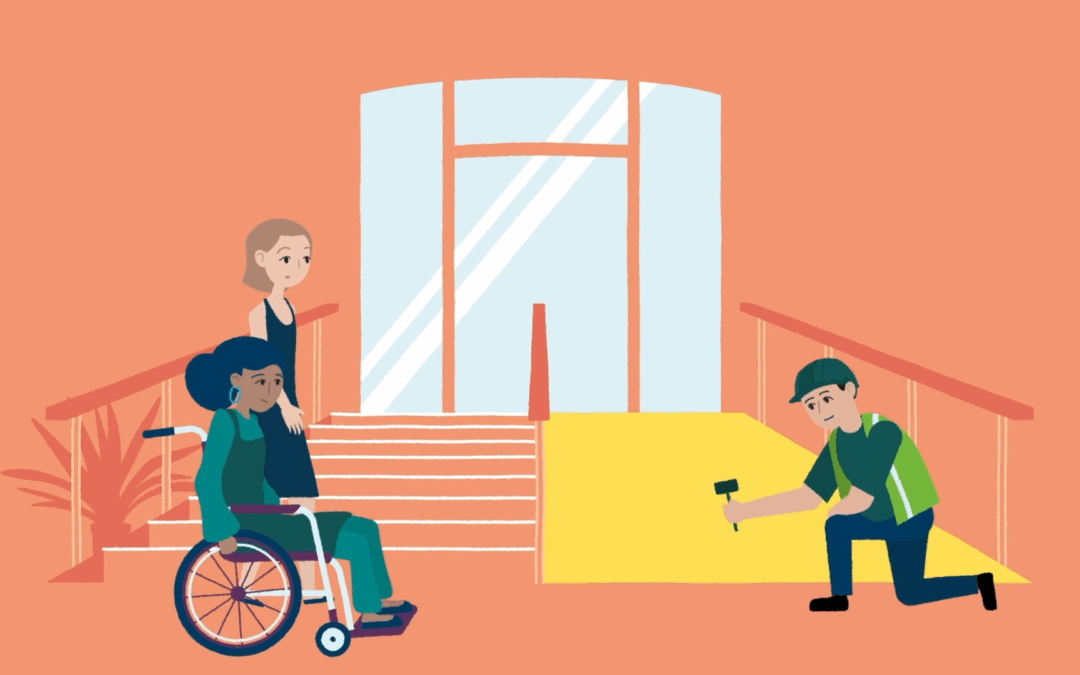
Instead of listing standards, the films focused on everyday movement through a city. Using public transport. Accessing information. Taking part in cultural life. In these moments, accessibility becomes tangible.
Animation was used to reduce reliance on spoken language and to keep the content inclusive and adaptable. It also allowed the films to remain relevant over time, rather than being tied to a single year or ceremony.
My role as Executive Producer
As Executive Producer, I was responsible for the coherence and long-term usefulness of the series.
This involved translating policy aims into visual narratives, ensuring accessibility principles shaped the communication itself, and maintaining consistency across multiple films produced over time.
I worked closely with the Access City Award team and colleagues within the European Commission. The process was collaborative and careful. The focus remained on clarity and integrity rather than performance or spectacle.
Accessibility, technology, and everyday life
Across Europe, technology increasingly shapes how disabled people navigate cities.
Assistive tools, navigation systems, communication aids, and accessible digital services all play a role in participation and independence. The Access City Award highlights how policy, design, and technology can work together when inclusion is taken seriously.
The films were used to share these approaches. Not as isolated success stories, but as examples other cities could learn from and adapt.
Distribution and reuse
The European Commission used the films across digital platforms, events, and award ceremonies.
Because the content relied on animation, it could be updated, subtitled, and localised without full re-production. Language versions and contextual edits allowed the same work to function across different European settings.
Over time, the series became more than promotional material. It acted as communication infrastructure, supporting sustained engagement with accessibility rather than one-off attention.
What changed
The films helped clarify what the Access City Award stands for and why it exists.
By focusing on lived experience rather than compliance, they supported wider engagement with accessibility initiatives. They also reinforced the award’s role as an ongoing process rather than a symbolic endpoint.
A closing reflection
Public sector communication often struggles to balance seriousness with accessibility.
This project showed that careful, well-governed animation can help bridge that gap. Used thoughtfully, AI-supported video does not replace policy or practice. It helps people see why those efforts matter, and how they connect to everyday life.
That was the purpose of this work.